
Mastering the Digital Loom: Agility, Curiosity, and AI
Adapting and Thriving With AI

Introduction
The world is changing faster than ever. Machines no longer just perform tasks — they think, predict, and optimize. AI is not coming; it is already here. Those who treat it as a threat will fall behind. Those who learn its rhythm, harness its power, and adapt their skills will shape the next era. Consider this a letter to your future self: evolve, innovate, and remain indispensable.
1. The Technological Arc — From Tubes to Thinking Machines
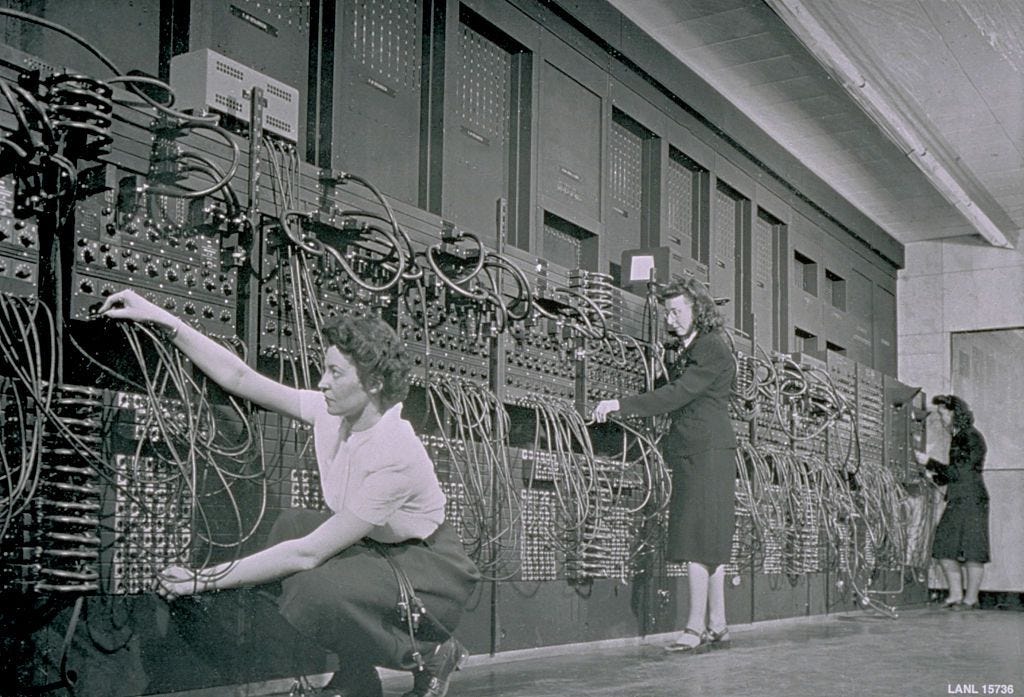
The first computers were mechanical beasts — room-sized vacuum tube contraptions that could barely handle arithmetic. ENIAC, built in 1945, weighed 30 tons, filled 1,800 square feet, and could perform about 5,000 additions per second. Today, your phone performs 11 trillion operations per second while fitting in your pocket.
The story of computing is the story of compression — from room to chip, from chip to neuron. We’ve reached 3nm chips with transistor counts in the hundreds of billions. Moore’s Law may be bending, but compute efficiency is exploding through parallelism, neuromorphic design, and quantum acceleration.
The bottleneck isn’t the machine anymore — it’s the human layer. We’ve built computational capacity faster than our ability to absorb it. We’ve made machines incredibly efficient, but our systems — education, governance, and industry — haven’t kept pace. The real inefficiency isn’t in computing; it’s in how slowly the world adapts to the speed of that computing power.
As Daniel Kahneman would note, the human mind tends to overvalue the visible — the machine, the interface, the metric — and undervalue the invisible — judgment, adaptation, and context. We’ve optimized hardware, but we’ve neglected the psychology of adjustment. We run faster, but often in the wrong direction.
2. Misuse of AI — Automation vs. Assistance
AI today mirrors early industrial misuse — automating for profit instead of augmenting for progress. We’re replacing human input rather than enhancing it. Customer service bots replace agents instead of empowering them to solve problems better. Generative models flood feeds with content but struggle to deepen creativity.
As Kahneman might observe, this is the “illusion of efficiency” — the belief that if something feels faster, it must be better. Airlines adopt self-check-in kiosks that save minutes but create hours of confusion when something breaks. Hospitals deploy diagnostic AI that flags every anomaly, burying doctors under false positives. Governments digitize forms that were meant to save time but end up multiplying friction.
These are not failures of technology — they are failures of understanding human cognition. Systems are built for automation, not augmentation. We keep chasing speed while neglecting sense.
We’re in the extraction phase — the part of the cycle where hype outpaces comprehension. Silicon Valley’s mantra of “move fast and break things” has turned into “move fast and extract value.” But this chaos is transitional. Like steam engines venting waste heat before turbines were perfected, this phase precedes synthesis.
True progress will come when AI transitions from replication to optimization — when it doesn’t just mimic humans, but refines how we think, create, and decide.
3. Industrial Analogy — Coal, Steam, and Jevons’ Paradox
There was a time when coal prices crashed. The steam engine — once crude and wasteful — became dramatically more efficient, consuming less coal per horsepower. Economists predicted that this would reduce demand. They were wrong.
Efficiency unleashed appetite. As engines became cheaper and better, factories multiplied. Railroads sprawled. Steel mills roared to life. Coal demand didn’t shrink — it exploded. This phenomenon, later coined Jevons’ Paradox, revealed an uncomfortable truth: every leap in efficiency makes the resource more indispensable.
The same dynamic is unfolding with AI. Each time we compress compute, optimize code, or train more efficient models, we don’t slow the system — we accelerate it. Data centers expand, GPUs multiply, and energy consumption scales. The machine becomes leaner, but the ecosystem fattens.
Our intuition fails us here: we assume efficiency leads to moderation. In truth, efficiency is fuel. It removes barriers, enabling expansion. Just as the steam engine reshaped cities around coal, the AI revolution is reorganizing civilization around computation — an invisible infrastructure of chips, models, and data flows.
The danger isn’t that AI will make us irrelevant. It’s that it will make us so efficient that our institutions — our schools, our laws, our economies — won’t adapt fast enough. The challenge isn’t obsolescence. It’s overdrive.
4. The Seamstress and the Loom — A Parable of Labor and Adaptation
In the 18th century, before the hum of machines filled the air, there was the rhythmic hush of needles and thread. The seamstress sat under the dim light of a candle, her fingers dancing across fabric. Every knot, every tie, every measured stitch was a language of precision — one that took years to master. She wasn’t just sewing; she was constructing the social fabric of her time. Textiles were power — they clothed armies, draped kings, and built trade empires. To be a seamstress was to be a vital cog in the world’s most influential industry.
Then came the mechanical loom. A device that could replicate, faster and more precisely, what once took human hands days to complete. It was a miracle — and a threat. Many seamstresses saw it as the death of craftsmanship, an end to artistry. But for those who looked closer, it was the birth of something larger. Those who learned to operate, maintain, and design for the loom became pioneers of a new profession. They didn’t lose their identity; they evolved into the architects of industrial progress.
The loom democratized textiles, transforming artistry into mass accessibility. It forced education systems to modernize, cities to reshape around factories, and governments to create labor laws. Every revolution reorganizes society around its new tool.
And today, the loom hums again — but this time, it’s neural. AI is the modern loom, weaving data instead of fabric. Once again, skilled labor feels under siege, and once again, a new class of creators will emerge — those who learn to command these systems. The seamstress didn’t lose her art; she lost her monopoly. Humanity never loses its role — it just changes its instrument And Acted as a catalyst to the industrial revolution
5. The AI Revolution — A Reset, Not a Regression
AI isn’t just industrialization 2.0 — it’s decentralization 3.0, but we’re squandering it the way early tech revolutions were misused. Picture a grocery store optimized by AI: it knows what sells, when demand spikes, which aisle to restock first, and what price moves inventory fastest. That’s efficiency. But when the algorithm’s goal becomes squeezing margins instead of reducing waste, we repeat the same trap that followed every tech breakthrough — extraction over empowerment. Inventory is moved faster so stockouts and stock-ins don’t have to happen at all. Employees can look after customer satisfaction.
Think of logistics AIs optimizing delivery routes until drivers have no room for breaks. Think of content models flooding feeds instead of fostering insight. This is how we’re misusing intelligence — as a profit engine, not a progress multiplier.
Yet, beneath this noise, the deeper reset is still happening. We’re reverting to pre‑industrial dynamics: small, agile nodes of creation, direct value exchange, micro‑enterprises powered by tools instead of institutions. The factory gives way to the freelancer. The office to the operator. The job to the journey.
This isn’t regression — it’s rediscovery. The age of the individual returns — only this time, with infrastructure that scales like a corporation. Personalization becomes production. Creativity becomes capital. And ambition — the rarest resource — becomes leverage.
6. Software Democratization: From Classroom Dreams to MSME Innovation
Think about what Zerodha did to stockbrokers—once, trading was the domain of the specialist, full of jargon and complex systems. Zerodha’s streamlined automation opened financial markets to everyone, making stock trading easy, transparent, and much less daunting.
Now, imagine the same transformation for software creation. Building reliable tools once took months, huge budgets, and a team of developers—the “gatekeepers” of innovation. But today, with AI copilots and no-code platforms, a local entrepreneur or small business owner (MSME) can spin up custom workflows, automate inventory, run marketing campaigns, and analyze customer data, all without writing a line of code.
Lovable Example: The Seventh Grader’s Journey
Picture a curious seventh grader named Aarav in a modern school system. Instead of rote memorization, his classroom uses AI-powered no-code tools for practical learning. Aarav’s assignment? “Solve a real-life problem unique to your town.”
Aarav notices local shops waste lots of fresh produce due to poor stock tracking. He decides to build a simple, automated alert system using drag-and-drop tools taught in class, connecting shop owners and farmers through a shared dashboard that warns when popular items are running low or at risk of spoilage.
His creation is celebrated at the school science fair—not just for its cleverness, but for using technology as an everyday solution. Teachers encourage these projects, knowing that early exposure to no-code and AI integrations plants seeds of creativity and problem-solving for the future.
Fast Forward: The Adult Entrepreneur
Years later, Aarav runs a small local grocery business. He faces a sudden supply chain challenge—deliveries delayed, stocks misaligned. Instead of waiting for expensive IT support or consultants, Aarav instantly launches a new workflow on his AI-powered dashboard, connecting suppliers directly to his shelves. He’s empowered to act fast and smart, solving problems that once crippled similar businesses.
Why AI in Education Is Essential
By teaching kids to use AI and no-code tools from a young age, we’re democratizing problem-solving. Students learn not only to dream up solutions, but to build them—in moments, not months.
When these kids grow up, they become MSME owners, managers, and leaders with the skills to adapt and pivot as technology changes. A child’s curiosity paired with modern software democratization becomes society’s engine for continuous progress.
Encouragement for Education Systems:
Every school should invest in practical, AI-enhanced digital learning. Encourage real-world projects, let kids build solutions with no-code tools, and reward their creativity. The world doesn’t need more passive consumers of technology—it needs active creators. That’s how we turn disruption into opportunity and ensure the next generation thrives, no matter how fast change comes.
Education + AI + No-code = a new generation of everyday innovators—ready to solve real problems, today and tomorrow.
7. From Corporations to Networks: The Age of Applied AI and the New Moat
The towering giants of the 20th century wore hierarchy like a crown—layers of management, rigid org charts, command from the top. But in the 21st, the game has changed. Today, the edge belongs to networks. Micro-brands, niche teams, and decentralized collectives outperform dinosaurs not because they’re bigger, but because they’re faster, more connected, and able to adapt in real time. AI is the spark accelerating this shift, flattening barriers and turning distributed efforts into new market leaders.
Forget factories—the next unicorns will look like federations: dynamic clusters, bound by trust, purpose, and seamless collaboration. In this new era:
Distribution is more powerful than product. Networks are more resilient than corporations.
But what does AI actually unlock in this world?
The real AI revolution isn’t about chatbots or flashy agents. It’s about embedding intelligence where the “real work” gets done—not abstract automation, but augmentation of human workflows. Most businesses don’t need another generic tool—they need systems tuned to how they truly operate: navigating undocumented shortcuts, gut calls, and the tacit knowledge that makes average teams great. This is the messy human layer—the real moat no code can replicate on its own.
Applied AI does the following:
Starts by observing, not coding: It’s about shadowing workers, capturing informal logic, and mapping the day-to-day realities that drive outcomes.
Models real-life decision frameworks: Good systems begin by asking “What does great look like here?” before a single line gets written.
Specializes before scaling: The best progress comes from studying one expert’s workflow—then scaling out, not building for vague generalities.
This approach is giving rise to a new practitioner—the Forward-Deployed AI Builder—someone who goes into the field, absorbs the wisdom behind the process, and creates assistive tools that amplify, rather than replace, human capability. These are AI observers, toolmakers, and workflow artists—not just consultants, but enablers who democratize efficiency and empower teams to work smarter.
8. Why This Is the Next Great Opportunity: The Senior AI Practitioner / AI Solution Architect
In the fast-evolving digital age, every company hums with invisible workflows: the way teams pass information, the shortcuts workers use to meet quotas, the unspoken logic behind a manager’s decisions. These unique, often undocumented patterns—organizational DNA—are where true operational excellence hides.
Generic automation can’t capture these nuances. When you deploy cookie-cutter bots, you get efficiency gains—but you level everyone to the same baseline. The real competitive edge belongs to companies that can see beneath the surface: map out, support, and amplify those hidden flows of expertise.
Applied AI is the amplifier. When tuned to your company’s unique “how,” AI becomes a force multiplier—scaling up what’s already great, surfacing exceptional tacit knowledge, and enabling nimble, adaptive networks. No more slow hierarchies—just empowered teams, flexible roles, and continuous innovation.
In this era:
Moats are no longer written in code—they’re embedded in culture.
Understanding how real work gets done is the only sustainable advantage.
The winners aren’t those with the most automation—they’re the ones who turn AI into empathy-driven, distributed systems, tailored to every unique snowflake of a company.
The Next Great Opportunity is Personal
This isn’t theory. Every department, every team, every worker has processes worth mapping and scaling. Turning AI into a universal workflow amplifier means giving everyone—from intern to executive—the power to do what once only giants could achieve. That’s why the opportunity is massive, real, and closer than ever.
9. Scenario: The Senior AI Practitioner Solves a Factory Bottleneck
Meet Priya, a Senior AI Orchestration Practitioner at a midsize electronics factory.
The Problem:
Every fall, production slows. Line supervisors know it happens right after new teams rotate in, but nobody can pin down what goes wrong. Meetings are held. Consultants are called. Output stays flat, morale dips, and nobody captures why the handoff between outgoing and incoming staff gets so rough.
Priya’s Approach:
Priya skips spreadsheets and flowcharts. For a week, she walks the floor—shadowing workers, taking notes, and recording conversations. She realizes:
Veteran workers use tricks—like subtle machine adjustments and personalized Kanban boards—never written in the manual.
Newcomers feel awkward asking repetitive questions, so they guess, make mistakes, or create their own workarounds.
Managers track anomalies in WhatsApp groups, keeping invisible logs of “known issues” for future reference.
The Solution: No-Code, Applied AI System
With these insights, Priya designs a custom no-code AI assistant using a drag-and-drop platform:
It listens for machine status updates and flags anomalies in plain language.
It pulls real insider tips from seasoned workers—turning unwritten steps into just-in-time pop-ups for new hires.
When an unfamiliar issue pops up, workers log it by voice. The AI clusters similar reports, prompting quick team huddles or auto-generating new training snippets.
Within weeks:
New staff onboard 2× faster.
Production delays during staff changes drop by 70%.
Morale jumps, as both veterans and newcomers feel heard and supported—the knowledge that “wasn’t in the manual” is now a shared asset.
The system adapts in real time, learning each team’s quirks and refining itself through feedback, not top-down mandates.
The Takeaway: Why Senior AI Practitioners Are the Future
Priya isn’t just an AI coder—she is a translator, systems observer, and workflow designer. Her value comes from empathy, curiosity, and operational immersion, not technical arrogance. By understanding human nuance, she builds solutions that transform companies at the root—not just the surface.
This is the true promise of applied AI:
Augmenting, not replacing, the team’s unique “way” of working.
Turning invisible expertise into digital assets.
Creating distributed systems where every worker—no matter their role—becomes an innovator.
As companies become networks, the Senior AI Practitioner becomes the architect of continuous improvement, connection, and collective intelligence.
This role is the new linchpin—where technology, people, and process meet to create not just efficiency, but enduring, adaptive intelligence.
10. The Age of Applied AI — Tools for the Real Work
The next AI opportunity isn’t in fancy agents — it’s in embedding AI where the real work happens.
Most people don’t need another chatbot; they need systems that understand how they actually work.
The real moat isn’t code — it’s understanding workflows. The biggest gap is between how companies say they work and how they actually operate — undocumented shortcuts, gut calls, and tacit expertise. AI’s true value lies in mapping and augmenting that human layer, not automating it away.
The process starts with observation, not development.
Shadow workers.
Capture informal logic.
Model decision frameworks.
Build evaluation-first, not agent-first. Define what “good” looks like before you write a single line of code.
Start with one expert’s workflow, then scale. That’s the rise of the Forward-Deployed AI Practitioner — people who embed with domain experts, understand operational reality, and build systems grounded in it.
Instead of AI consultants, we’ll have AI observers and toolmakers — those who study how humans work and build systems to make them more efficient. AI becomes a workflow amplifier, not a replacement engine.
11. The Mindset Shift
Stop saying AI will take your job.
Start learning how to make it work for you.
Because disruption doesn’t ask for permission — it just happens.
Be insecure enough to stay hungry.
Be curious enough to stay relevant.
Be agile enough to stay alive.
AI makes personal genius accessible. You don’t need a coder; you need vision and drive. It’s a generalist’s toolkit — Einstein, Picasso, analyst, and dietitian — all in your pocket. AI amplifies ambition, but only if you know how to direct it.
The World Is Changing. AI will impact infrastructure, healthcare, and education. We should be the people moving it forward, not consuming AI‑generated slop.
It's interesting how the human side becomes the realy legacy code problem.